
Superb Old War Shield, Bahinemo People, Upper April River Hunstein Mountain Ranges East Sepik Province Papua New Guinea,
Enquire About This Artworks >
| Collection No. | T-6006 |
|---|---|
| Size | Height 183cm x 50cm width) |
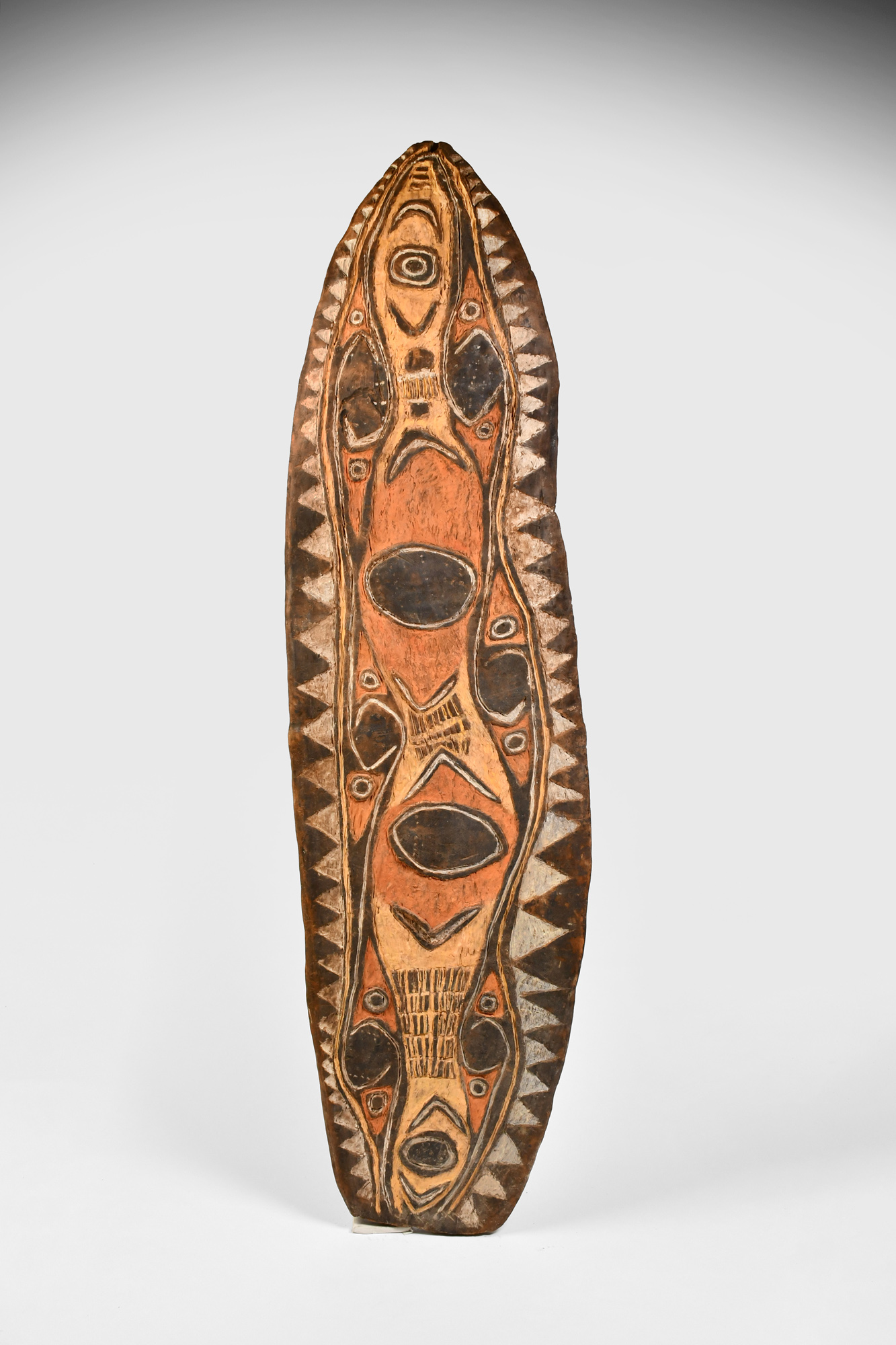
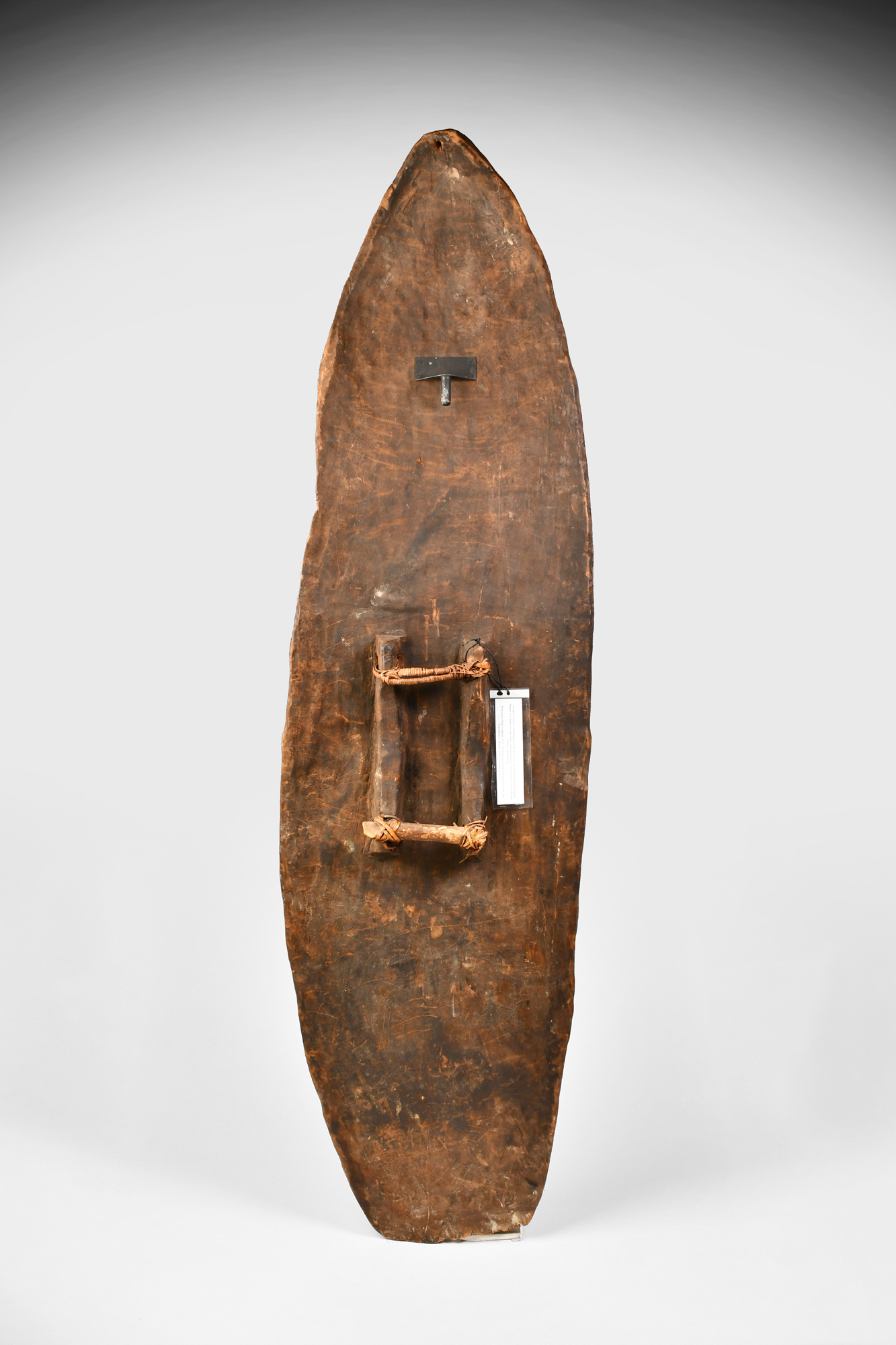
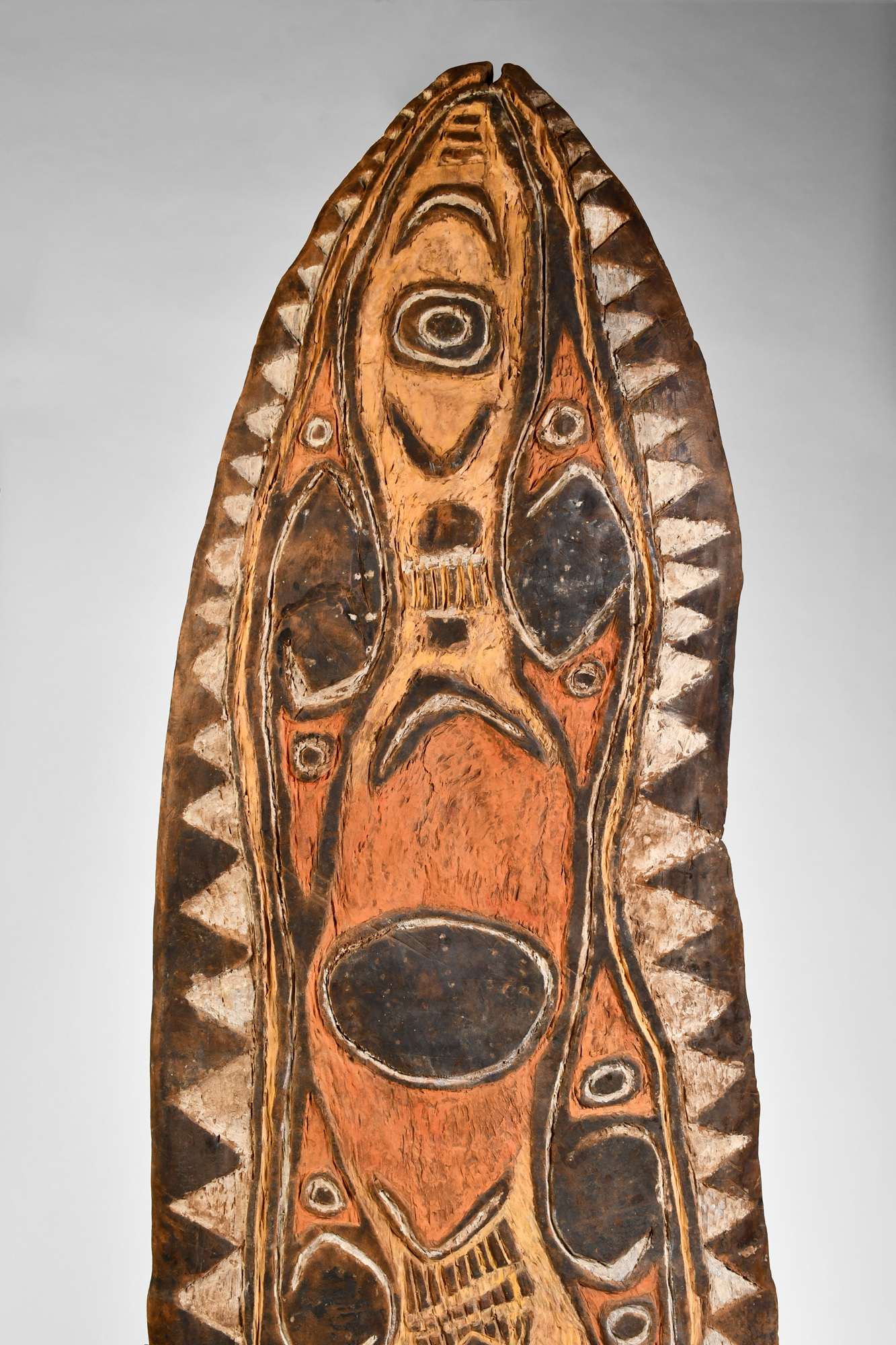
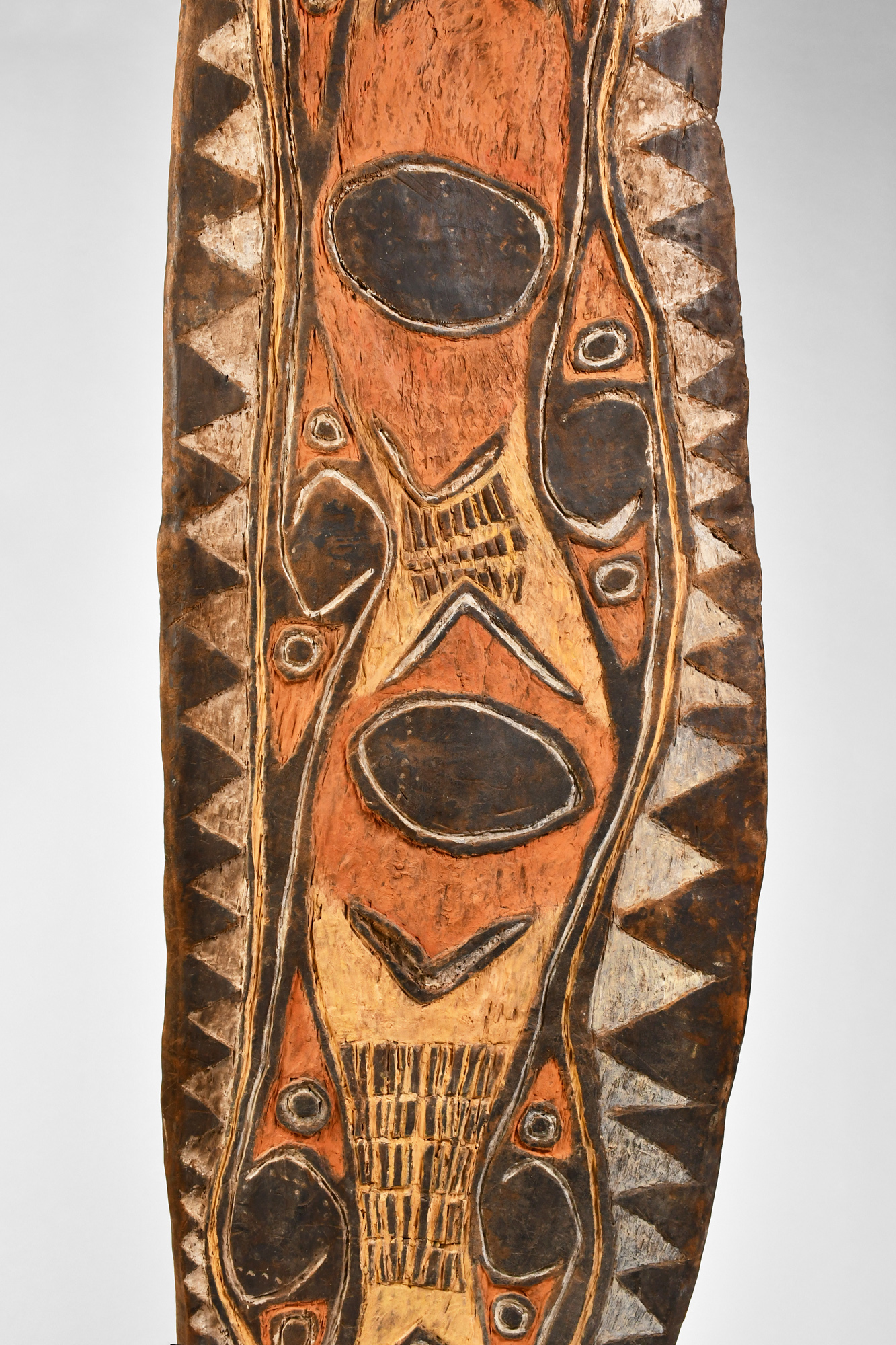
A Superb Old War Shield, Bahinemo People, Upper April River Hunstein Mountain Ranges East Sepik Province, Papua New Guinea, Stone Carved & 19th Century
This beautiful shield of great age and a very rare type, stone carved and pre-contact.
Upper Sepik, shields conveyed an image of the clan spirits that protected the warrior, their eyes confronting the enemy or any perceived human threat. Each warrior would know the clan symbols of his opponents as well as his own. Seen from a distance, the dramatic colours of the designs emphasised the power that one’s enemies were conjuring up to protect them. When confronting an enemy’s shield in any sort of tribal fight, one confronted the face of the spirit that protected that enemy warrior. Imagine the power of six or ten of these stylized faces of clan spirits glaring at you as you encounter a group of opposing warriors.
There are similarities in form between shields from several different peoples living in the Upper Sepik region, including the Saniyo, who live along much of the Wogamush River, part of the middle Leonard Schultze River, and the west bank of the middle April River, and the Bahinemo, who live on the east bank of the middle April River and in the Hunstein Range. As Craig notes, “the practice of attributing to shields to rivers rather than to particular settlements or peoples on those rivers has been confusing. This has come about because explorers, government officers and traders travelled along the rivers that were the tribal boundaries in pre-contact times and the people moved their villages from inland locations to the rivers banks” (Beran and Craig, eds., Shields of Melanesia, Adelaide, 2005, p. 81). Following this practice, shields of similar form to the present lot have tended to be identified simply as “April River”.
We may attempt a more precise identification in this case, noting the close correspondence of this shield with Craig’s description of the characteristics of Bahinemo war shields, known as tiah. As with the present shield, these shields are generally oval with horizontal handles attached to two or four vertical ridges carved at the rear of the shield. Craig notes that the design “is usually framed with dentate, a continuous zigzag or a series of small chevrons […and] the central part of the design [is] a vertical repetition of faces with a column of spirals on each side […]” (ibid., p. 82). In the present shield these features are notable for their bold and deeply carved graphic quality and the expressive quality of the faces, the design executed in perfect harmony with the beautiful undulating form of the shield itself.
The abstract faces might be representing the culture hero Wulruwiyanggwət (Newton, 1975: 209). Newton also states that Upper Sepik shields “were identified with major ancestral spirits, some of them at least water-spirits.”
Provenance Philip Goldman (1922– 2012), Private Collection & The Todd Barlin Collection of New Guinea Oceanic Art
Philip Goldman was removed from the RAF at the end of the war because of tuberculosis, after which he pursued a career in electronics. He ran a small business with his wife, Rosalind, but was fascinated by exotic art. Jimmy McMullan, at the Obelisk Gallery on Crawford Street, encouraged them to open a small gallery at 43 George Street, off Marylebone High Street, where they sold art from Africa, Melanesia and the Far East, beginning in 1960. It was there that I first met Philip in the winter of 1961, and the Oriental art I saw was probably on sale or on return from Jimmy. The gallery was next door to another tribal art dealer, Herbert Rieser. Business was slow but picked up when they moved eight years later to Davies Street, just off Berkeley Square. It was near William Ohly’s Berkeley Galleries, which was then run by William’s son, Ernest, who also sold art from the Far East, Africa and Oceania. Americans and other important collectors such as John Friede and the Sainsburys became clients. We all enjoyed the summer parties that Rosalind and Philip gave in their house in a huge garden in Finchley. The American company for which Philip worked sent him to New Guinea in 1957, the first of several trips he made during the next twelve years. He first went up the Sepik River to buy from the traders there, but later he explored the Highland region, acquiring some of the finest door panels from the Telefomin region and the distinctive Hunstein Mountain carvings with their curved spikes. Alas, we have no record from whom he bought the fabulous Karawari hook figure that he sold to Bill Rubin, the then director of MOMA, New York, nor the Malu Board now in the Sze Collection. In fact, no records of transactions survive. They retained the name Gallery 43, which sold art from Africa, Oceania and the Far East, but Philip’s favorited remained that of New Guinea.
See my new EXHIBITIONS GALLERY showing the Museums and Art Galleries Exhibitions that I provided artworks for over the past 40 years. There is the link to the article about my artworks published in the prestigious Louvre Magazine in 1996
I have artwork for Museums and art Galleries but also for collectors at every stage of their collecting. I want to encourage people to explore the fine art of New Guinea & West Papua and the Pacific Islands and to be able to see and touch the artworks in a relaxed and friendly manner in my Sydney Gallery. I would like to invite you to visit my gallery and see the artworks in person and also look at my website www.oceanicartsaustralia.com where there are many Galleries & Sub Galleries to explore.
My Gallery of nearly 40 years is the last physical gallery in Sydney that specializes in New Guinea and Oceanic Art. Sydney is very close to New Guinea & the Pacific Islands where all of these amazing artworks came from, Australia’s closest neighbours.
To see many more rare items and the finest masterpieces, please make an appointment with us to visit the gallery.
For all inquiries, please contact us