
A Superb Old Austral Islands Dance Paddle Austral Islands Polynesia 19th Century
Enquire About This Artworks >
| Collection No. | SOLD but see lots more Fine Oceanic & Aboriginal Art on my website |
|---|---|
| Size | 89 x 21cm |
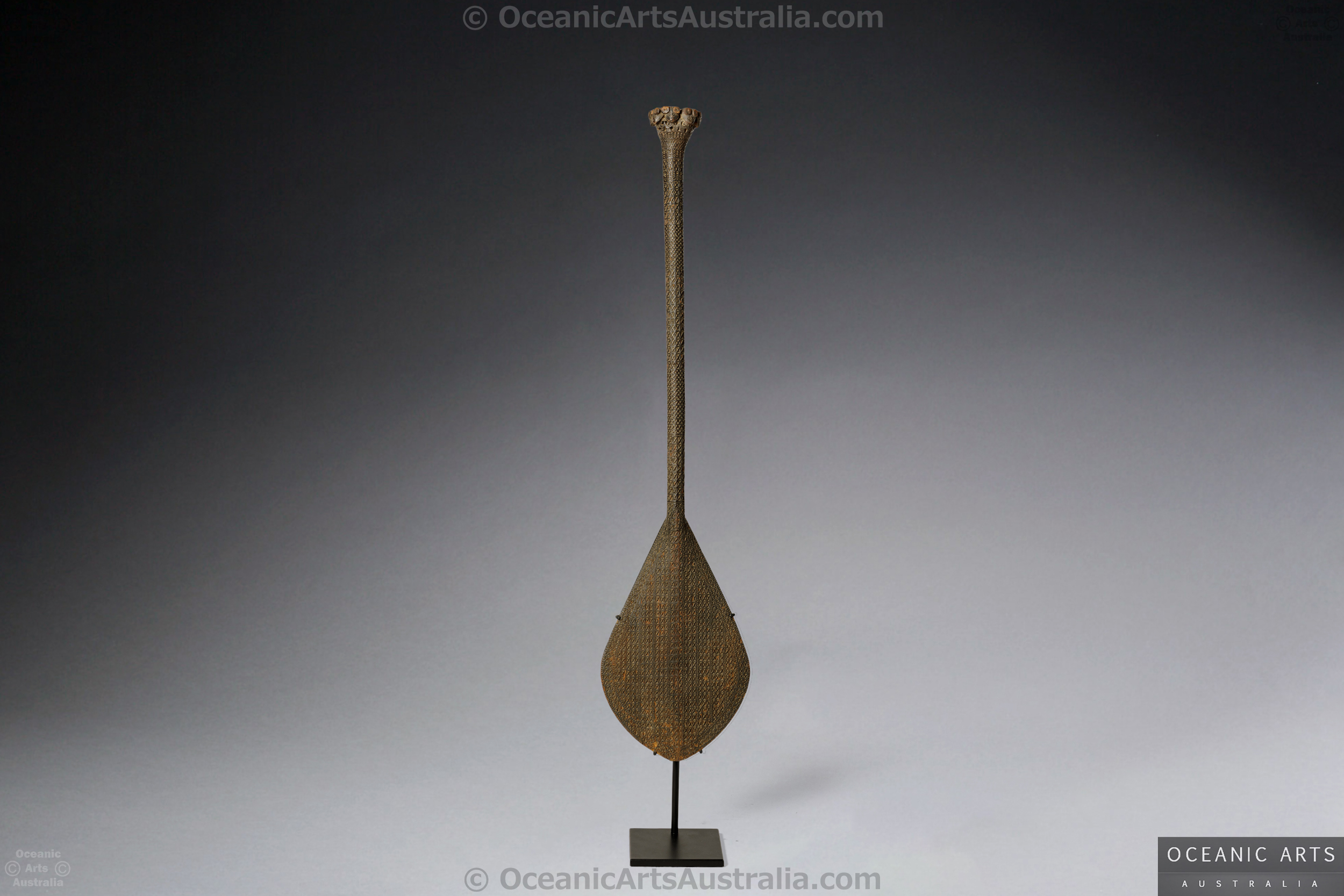
A Superb Old Austral Islands Dance Paddle Austral Islands Polynesia 19th Century Circa 1880s
This finely carved 19th Century Dance Paddle is from the Austral Islands which are the southernmost group of islands in French Polynesia.
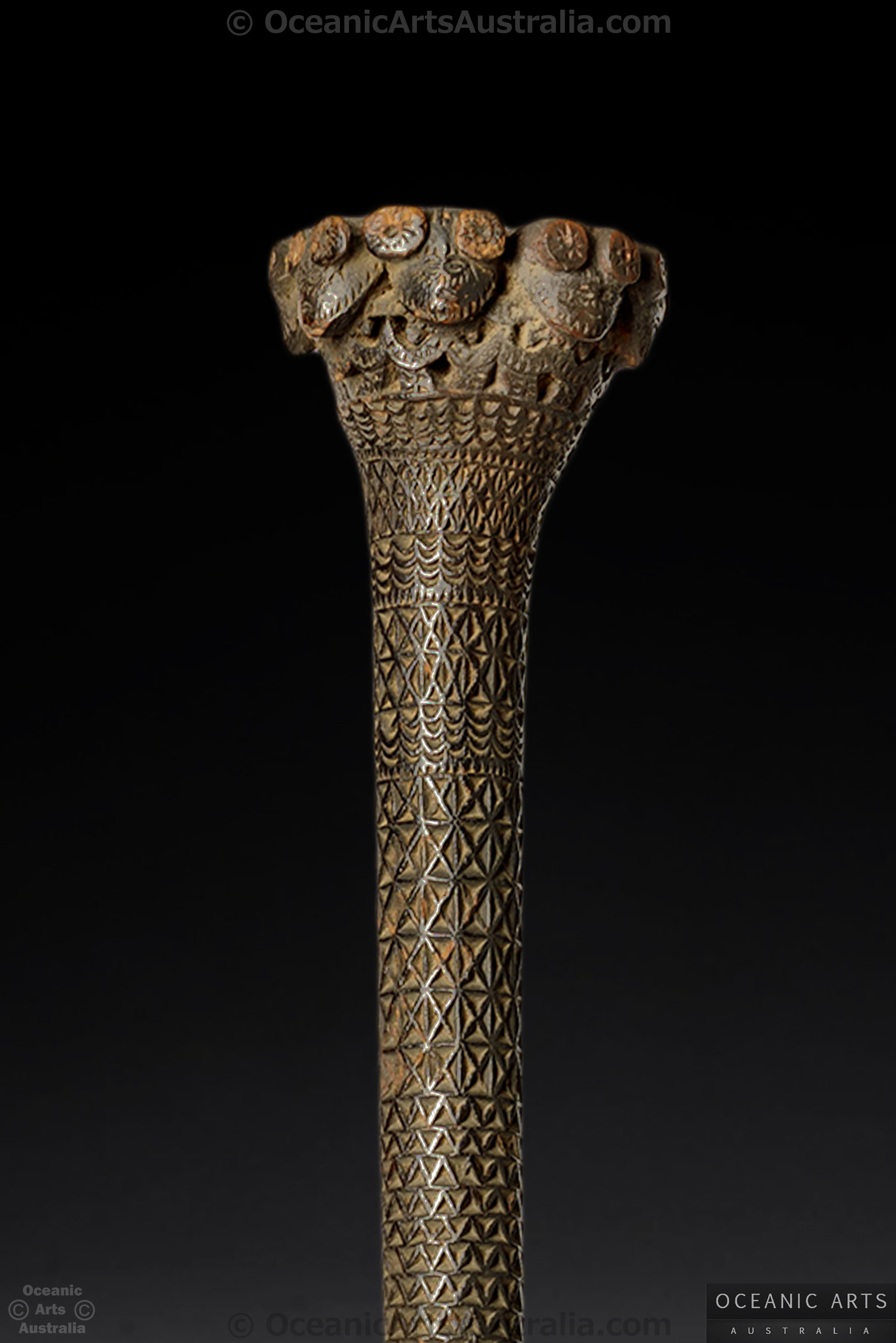
Carved from a single piece of medium wood the tiny chip-carved designs cover the entire surface on both sides of the paddle and the finial is carved with seven fine Tiki heads in a circle. This Dance Paddle is in nearly perfect condition which is rare, it is dating from the 1870-1880 period when these were made for trade with visiting European ships that occasionally stopped by the islands for fresh water. In the pre-European contact era, there were likely similar Dance Paddles made and used for traditional ceremonies and as objects of prestige.
According to the expert on these paddles: Rhys Richards in The Tribal Arts Magazine (2012, pp 141 – 145),
“Though widely called ‘paddles,’ these objects are not functional paddles. They are ‘paddle shaped,’ but their sizes are too extreme; their shafts are too weak, and they are thoroughly unsuitable for use as paddles. Consequently, it has been assumed that they were emblems of rank or status, for ceremonial rather than functional use. But an exhaustive survey of the historical sources, has confirmed that there are no known eye-witness accounts of their use or function. No local name is recorded for them, anywhere, before 1890, though they are sometimes called ‘hoe‘ after the Tahitian word for paddle. Most Austral Island paddles are dated roughly between 1820 – 1840, mostly made probably on the Island of Raivavae, and are generally described as made for trade items, with their original use being treated as something of a mystery. Their form varies depending mainly on length, with longer paddles in excess of 120cm generally considered the most elegant. The pommel is encircled by 11 protruding heads tapering to a slender cylindrical shaft and lanceolate blade, incised with an ornate finely carved geometric motif over the surface. In general older Austral island paddles tend to be smaller and have round pommels. Square pommels and larger paddles are later in production. The more eccentric double-bladed or double-handled varieties are also later. This example is smaller and has a rounded pommel. Based on the glossy dark brown patina, rounded pommel, and smaller size I would date it to late 1700s – early 1800s.
There are good grounds for asserting however that few if any ‘paddles’ were made and exported after 1842. Firstly, the population decline was extreme, particularly among the adults, and dead men made no paddles. By 1840 the total population of Tabuai had fallen to 250 and on Raivave to 360…Actual carvers would have been even fewer. Moreover, after the French took over Tahiti in 1842, trade visits to the Austral Islands declined.”
Provenance: The Todd Barlin Collection of New Guinea & Polynesian Oceanic Art
See my new EXHIBITIONS GALLERY showing the Museums and Art Galleries Exhibitions that I provided artworks for over the past 40 years. There is the link to the article about my artworks published in the prestigious Louvre Magazine in 1996
I have artwork for Museums and art Galleries but also for collectors at every stage of their collecting. I want to encourage people to explore the fine art of New Guinea & West Papua and the Pacific Islands and to be able to see and touch the artworks in a relaxed and friendly manner in my Sydney Gallery. I would like to invite you to visit my gallery and see the artworks in person and also look at my website www.oceanicartsaustralia.com where there are many Galleries & Sub Galleries to explore.
My Gallery of nearly 40 years is the last physical gallery in Sydney that specializes in New Guinea and Oceanic Art. Sydney is very close to New Guinea & the Pacific Islands where all of these amazing artworks came from, Australia’s closest neighbours.
To see many more rare items and the finest masterpieces, please make an appointment with us to visit the gallery.
For all inquiries, please contact us